Rotational Molding vs Blow Molding: What’s the Difference?
Rotational Molding vs Blow Molding: What’s the Difference?
If you work around plastic manufacturing long enough, two processes come up again and again: rotational molding and blow molding.
Both methods create hollow plastic parts. At a glance, the finished products can even look similar. But the way those parts are made—and how they perform in the real world—can be very different.
Blow molding is commonly used for things like bottles and packaging. Rotational molding is often used for larger, more durable products such as industrial containers, storage tanks, and water-filled construction barricades.
If you're evaluating manufacturing options for a plastic product, understanding how these two processes differ can help you make a much clearer decision.
Rotational Molding vs Blow Molding: Key Differences
Rotational molding and blow molding are two manufacturing processes used to create hollow plastic products. The primary difference is how plastic forms inside the mold.
Rotational molding: Plastic powder is heated inside a rotating mold, coating the interior evenly and forming a seamless part.
Blow molding: Molten plastic is inflated with compressed air inside a mold, similar to blowing up a balloon.
Rotational molding is commonly used for durable products like industrial containers, tanks, and water-filled barricades. Blow molding is typically used for high-volume products like bottles and packaging.
Quick Comparison
Feature | Rotational Molding | Blow Molding |
|---|---|---|
Material Form | Plastic powder | Molten plastic tube (parison) |
Process | Mold rotates while plastic melts | Air inflates plastic inside mold |
Corner Thickness | Often thicker and reinforced | Often thinner due to stretching |
Typical Products | Industrial bins, tanks, barricades | Bottles, containers, packaging |
Best For | Durable large parts | High-volume production |
What Is Rotational Molding?
Rotational molding is a manufacturing process used to create hollow plastic parts by heating plastic powder inside a rotating mold.
The mold rotates on two axes while the plastic melts and coats the interior surface evenly. Once the material cools, the mold is opened and the finished product is removed.
This process produces seamless plastic parts with strong corners and consistent wall thickness. Rotational molding is commonly used to manufacture industrial containers, agricultural tanks, playground equipment, and water-filled construction barricades.
Learn more in our Rotational Molding guide.
What Is Blow Molding?
Blow molding is a manufacturing process that forms hollow plastic parts by inflating molten plastic inside a mold.
A tube of melted plastic—called a parison—is placed between mold halves. Compressed air inflates the plastic until it expands and takes the shape of the mold.
Blow molding is widely used for products like plastic bottles, chemical containers, and packaging because it allows extremely high production speeds.
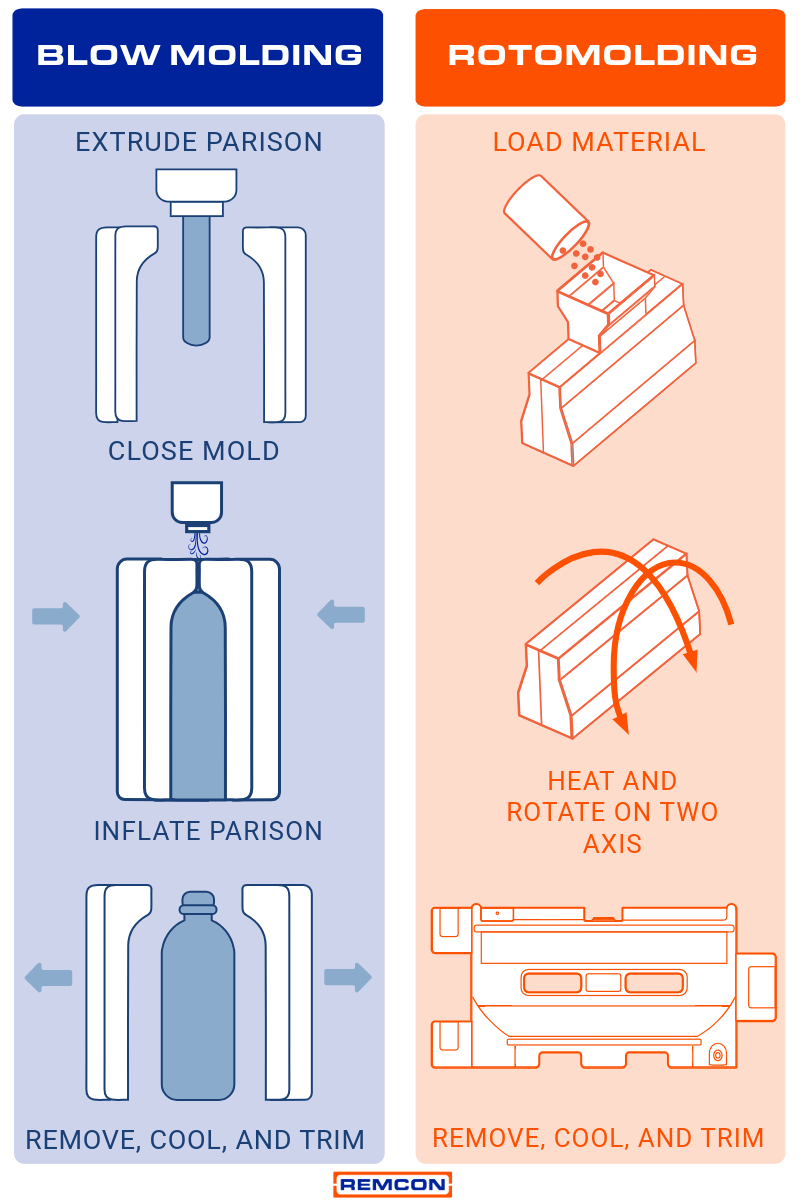
How Rotational Molding Works
Rotational molding—often called rotomolding—creates durable hollow plastic products through a controlled heating and rotation process.
Plastic powder is loaded into a mold
The mold is heated inside an oven
The mold rotates slowly on two axes
The plastic melts and coats the interior surface
The mold cools while continuing to rotate
The finished part is removed
Because the mold rotates while the plastic melts, material distributes evenly across the interior. The result is a single-piece product with no seams or weld lines.
This construction method contributes to excellent durability in products designed for heavy use.
How Blow Molding Works
Blow molding uses air pressure to shape molten plastic into hollow forms.
Plastic is melted and formed into a tube called a parison
The parison is placed between mold halves
Compressed air inflates the plastic
The plastic expands until it touches the mold walls
The part cools and excess material is trimmed
This method is extremely efficient for high-volume production, which is why it’s widely used for packaging applications.
Key Differences Between Rotational Molding and Blow Molding
Material Distribution
Rotational molding distributes material gradually across the mold interior, often creating thicker corners and reinforced stress points.
Blow molding stretches plastic during inflation, which can result in thinner material in certain areas depending on the product shape.
Durability
Rotomolded products are often built for demanding environments where durability and impact resistance are important.
Blow-molded products are usually optimized for lightweight construction and rapid production.
Design Flexibility
Rotational molding allows manufacturers to create:
Large hollow parts
Integrated structural features
Thick corners
Seamless one-piece construction
Blow molding works best for simpler shapes and high-volume production runs.
When Rotational Molding Is the Better Choice
Rotational molding is commonly chosen when products require durability and long service life.
Typical examples include:
Industrial material handling containers
Water-filled construction barricades
Agricultural tanks
Outdoor equipment
Playground structures
These applications often involve outdoor exposure, heavy loads, or repeated impacts.
When Blow Molding Makes More Sense
Blow molding is ideal when production speed and volume are the highest priorities.
Common examples include:
Beverage bottles
Household chemical containers
Plastic drums
Automotive fuel tanks
Consumer packaging
Frequently Asked Questions
Is rotational molding stronger than blow molding?
In many industrial applications, rotational molding produces stronger parts because the material distributes evenly and often forms thicker corners, improving durability and impact resistance.
What products are made using rotational molding?
Rotational molding is commonly used for industrial plastic bins, storage tanks, agricultural containers, playground equipment, and water-filled barricades.
Why are rotomolded corners thicker?
During rotational molding, plastic flows naturally within the rotating mold. Corners often accumulate slightly more material, which reinforces high-stress areas.
Is blow molding cheaper than rotational molding?
Blow molding can be more cost-efficient for high-volume packaging products. Rotational molding is typically chosen when durability and structural performance matter more.
Can both processes create large plastic parts?
Yes, but rotational molding is generally better suited for very large hollow products such as tanks, containers, and construction barricades.
Conclusion
Rotational molding and blow molding are both valuable manufacturing methods, but they serve different purposes.
Blow molding is ideal for high-volume packaging and lightweight containers. Rotational molding is often the better choice for large, durable plastic products that must withstand demanding real-world conditions.
Understanding these differences helps designers, engineers, and buyers choose the manufacturing process that best fits their application.

WE'VE BEEN DOING THIS FOR A WHILE
Call us first, because if we can't solve your problem, we'll tell you who can.